In most diamond painting kits, each standard drill color is identified by a DMC code, usually a three- or four-digit number printed on the bag and repeated in the symbol chart. The standard diamond painting palette is commonly described as containing 447 colors, while one kit normally uses between 20 and 60.
Some brands use their own numbering systems, but kits based on DMC codes make it easier to match symbols, request replacement colors and sort leftover drills from different diamond painting kits.
A missing or mismatched color is one of the most common issues reported to our support desk, and the first thing we ask for is the DMC code.
Quick Answers
- Colors in the commonly used drill palette: 447
- Colors used in one kit: usually 20 to 60
- Estimated drill positions in a 40x50 cm (16x20 in) full-drill canvas: 32,000 square or about 25,276 round
- Reading a canvas: symbol → legend → color code → drill bag
What Is a DMC Color Chart?
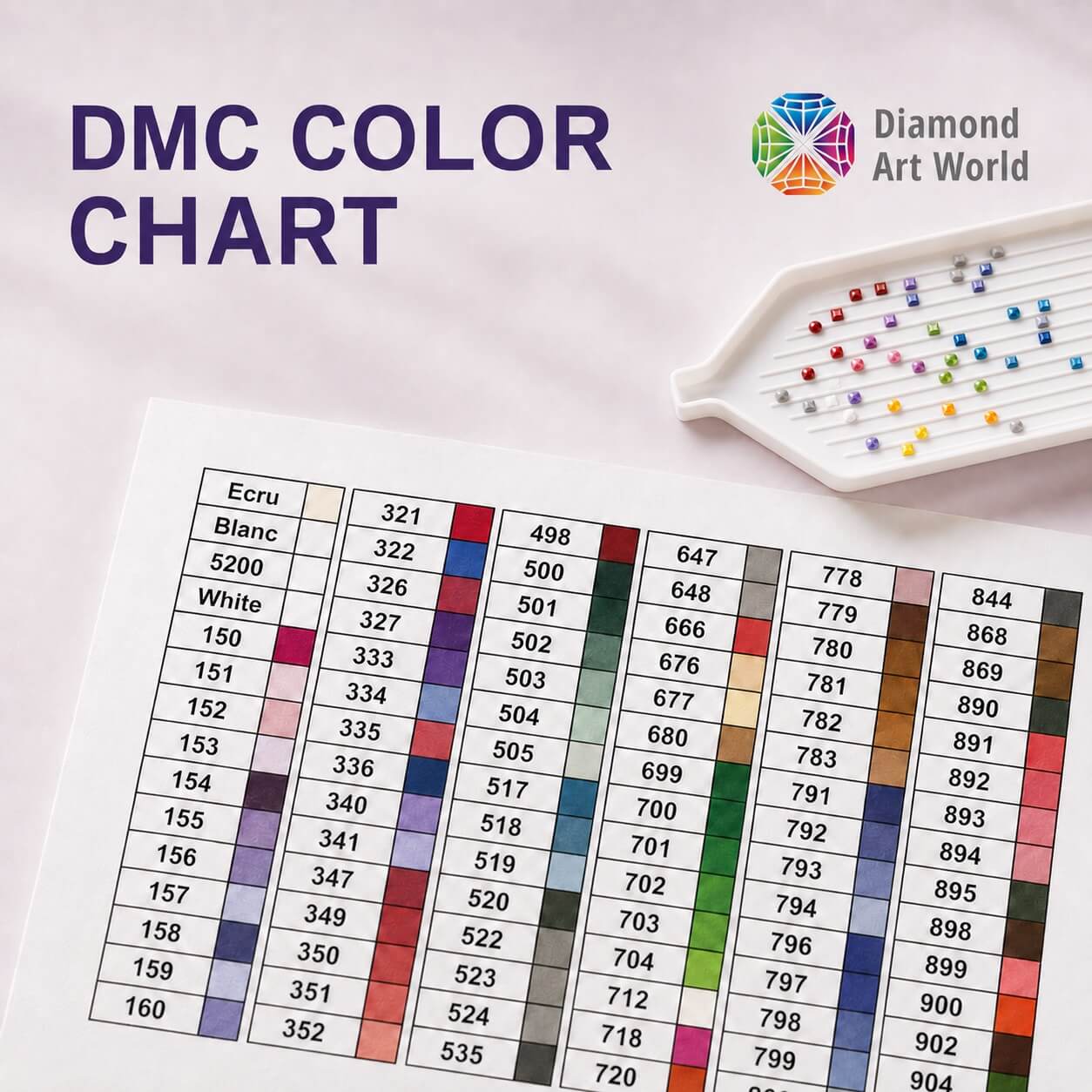
A DMC color chart lists color codes beside the shades they represent. It may be a printed card, a downloadable chart or a homemade reference made with real drills.
The system comes from embroidery. DMC is a French thread manufacturer whose numbering system has been used to identify floss colors for decades. Diamond painting manufacturers later adopted many of the same codes for resin drills.
In a kit that uses the DMC system, one code connects the color in several places:
- on the drill bag
- in the legend printed on or supplied with the canvas
- on replacement drills sold by suppliers using DMC codes
- on the corresponding DMC embroidery floss
The code is the useful part. Color names can vary between charts, and resin drills may not look identical to embroidery thread because the materials reflect light differently. If one chart calls 317 "Pewter Gray" and another uses a slightly different name, the code still points to the same target color.
Most codes are numeric. A few familiar exceptions include Blanc (white), Ecru (off-white) and B5200 (snow white).

How Many DMC Colors Are Used in Diamond Painting?
The standard answer is 447 colors, but suppliers do not all stock exactly the same range.
You may also see other figures:
- 445 — some suppliers carry 447 colors in square drills but omit Blanc and Ecru from their round-drill range.
- More than 447 — some drill manufacturers have added newer DMC shades, while others continue to use the traditional palette.
- 489 — DMC sells a 489-color embroidery floss set, but this is a thread product rather than a standard diamond painting drill range.
Specialty embroidery lines and the standard drill palette should not be counted as if they were the same product range. When ordering replacements, check that the seller carries the code, drill shape and finish you need.
How Many Colors Does One Kit Use?
Most diamond art designs use between 20 and 60 colors.
That pattern is also visible across our catalogue. Graphic designs, single subjects and mini kits usually sit at the lower end. Photorealistic landscapes, portraits and images with skin tones or soft gradients need more neighboring shades to keep transitions from looking abrupt.
More colors mean more bags to organize and more switching while you work. Two canvases of the same size can therefore take different amounts of time. Our guide explains in more detail how long a diamond painting takes.
How to Read the Symbol Chart on Your Canvas
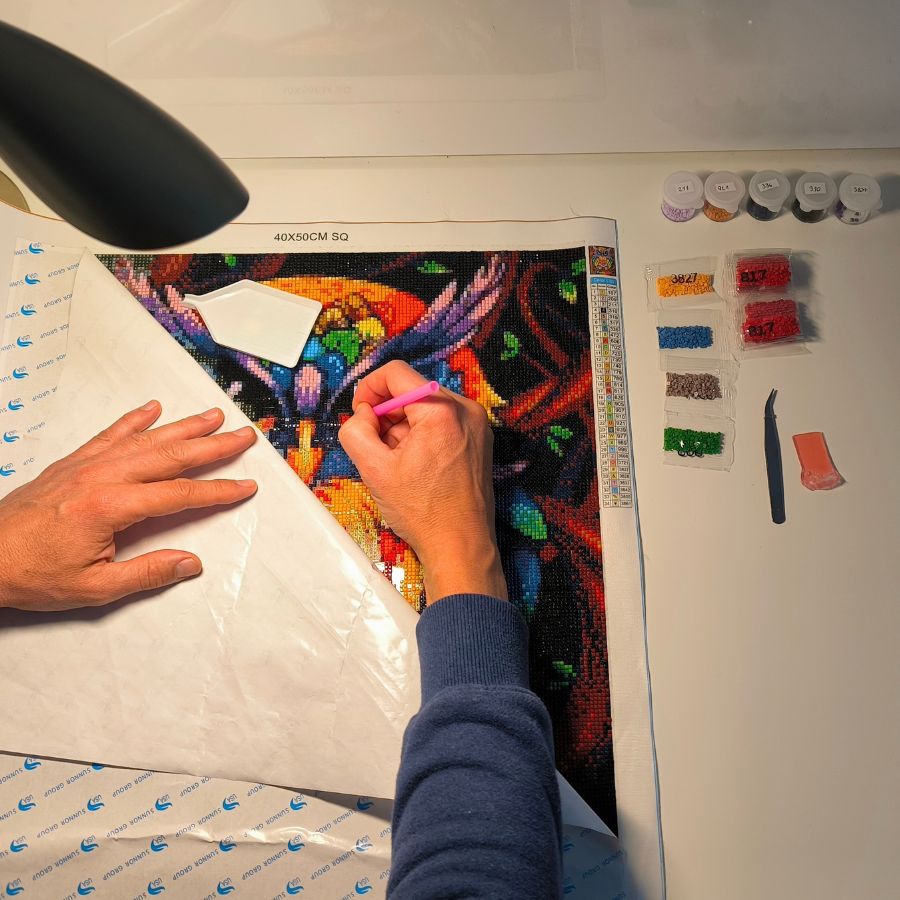
The chain is simple: symbol on the canvas → legend → color code → drill bag.
The legend is usually printed along one edge of the canvas or supplied as a separate reference sheet. Each line pairs a symbol used in the design with the code printed on the correct bag of drills.
Watch for similar symbols. Under weak light, B and 8 or S and 5 are easy to confuse. One misread symbol can put an entire section in the wrong shade. Better lighting and checking the legend twice usually prevent the problem.
Trust the code, not a quick visual comparison. A palette with hundreds of colors contains many near matches. Two greys can look identical in a tray but clearly different once placed side by side on the canvas.
If you are working through your first kit, the full placement process is covered in our guide to how to do diamond painting.

How Many Diamonds Are in a Diamond Painting?
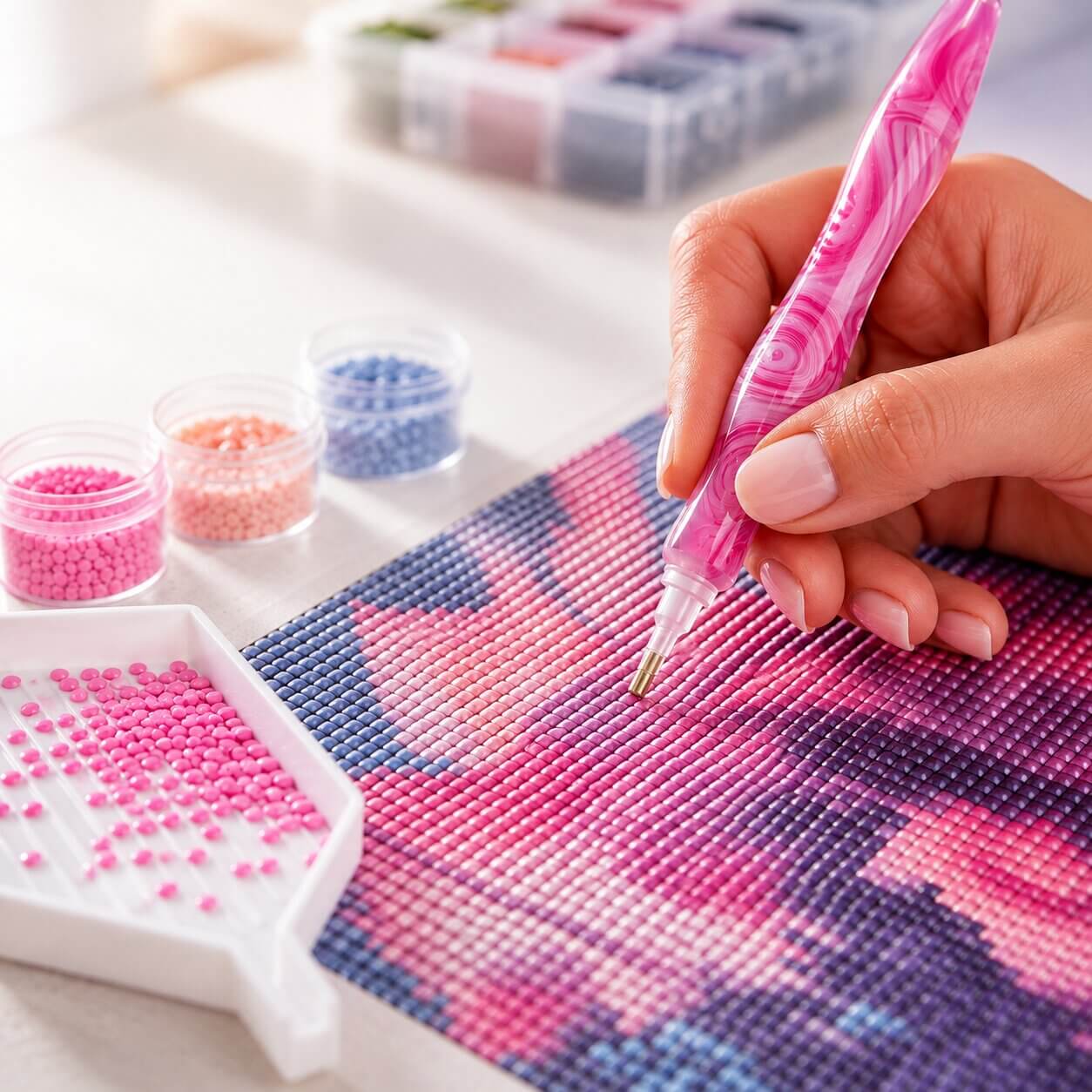
Drills are also called beads, gems or rhinestones. In a full-drill kit, every cell in the covered grid takes one drill, so the estimated count comes from the size of the drill area and the spacing of the grid.
Standard square drills are approximately 2.5 mm wide, which allows four drill positions per centimeter. Round drills are commonly about 2.8 mm wide, or approximately 3.57 positions per centimeter. The table below uses those nominal measurements.
Square drill estimate: floor(width in cm × 4) × floor(height in cm × 4)
Round drill estimate: floor(width in cm ÷ 0.28) × floor(height in cm ÷ 0.28)
These are estimates for the covered drill area, not guaranteed manufacturer counts. The actual grid may vary slightly, and a listed canvas size sometimes includes a border outside the image.
| Drill area | Square drills (2.5 mm) | Round drills (2.8 mm) |
|---|---|---|
| 20x20 cm (8x8 in) | 6,400 | 5,041 |
| 20x30 cm (8x12 in) | 9,600 | 7,597 |
| 25x25 cm (10x10 in) | 10,000 | 7,921 |
| 30x30 cm (12x12 in) | 14,400 | 11,449 |
| 30x40 cm (12x16 in) | 19,200 | 15,194 |
| 35x45 cm (14x18 in) | 25,200 | 20,000 |
| 40x40 cm (16x16 in) | 25,600 | 20,164 |
| 40x50 cm (16x20 in) | 32,000 | 25,276 |
| 40x60 cm (16x24 in) | 38,400 | 30,388 |
| 50x60 cm (20x24 in) | 48,000 | 38,092 |
| 50x70 cm (20x28 in) | 56,000 | 44,500 |
| 60x60 cm (24x24 in) | 57,600 | 45,796 |
| 60x80 cm (24x32 in) | 76,800 | 60,990 |
| 70x100 cm (28x40 in) | 112,000 | 89,250 |
| 80x100 cm (32x40 in) | 128,000 | 101,745 |
The inch figures are rounded equivalents of the metric dimensions. A canvas that measures exactly 16x20 inches is slightly larger than a 40x50 cm canvas and may contain more drill positions.
The subject of the image does not change the number of positions in a full-drill grid. A plain sky and a detailed foreground use the same total number when their covered dimensions and drill shape are identical. Partial-drill kits are different because only selected areas receive drills.
Canvas size determines the amount of placement work, while the number of colors affects how often you must stop, change bags and organize trays.
Do AB, Glow and Specialty Drills Have DMC Codes?
AB stands for Aurora Borealis. An AB drill has an iridescent coating over its base color. Suppliers often label it with a standard code plus an AB marker, such as 310 AB, although specialty labeling is not fully standardized across brands.

Glow-in-the-dark drills, crystals and special shapes such as teardrops usually fall outside the standard palette. Manufacturers may give them their own numbers because there is no single industry-wide code for every specialty finish and shape.
Our separate guide explains the differences between standard, AB, glow, round and square diamond painting drills.
Making Your Own DMC Color Card
A physical DMC color card is useful when you are holding a loose drill with no labeled bag and need to identify it.
Printed and digital charts reproduce shades as ink or pixels. A real drill is glossy, faceted and affected by the surrounding light, so two neighboring shades can be difficult to match against a screen. Comparing the loose drill with another real drill is more reliable.
Glue or tape one drill onto card stock next to its code. Add a new sample whenever a kit contains a color you do not already have, and keep the codes in numerical order so the card remains easy to scan.
This is the method we most often recommend to customers building a large stash. It takes some setup, but it removes most of the guessing later.
Photograph the completed card in good daylight, making sure the codes remain readable. The photo is useful for checking which codes you already own while shopping, although the physical card is still better for precise color matching.
Using DMC Codes to Sort Leftover Drills
When two kits use the DMC system, drills carrying the same code are intended to represent the same color. That lets you store leftovers by code instead of keeping a separate container for every kit.
Small differences between manufacturers and production batches are still possible. They are most visible when drills from different batches are mixed across one large, flat section such as a sky or background. Compare them in daylight before combining them in the same area.
Label every container with its code. "Dark blue" stops being useful once you own several similar shades. Containers, bottles and labeled boxes are available in our diamond painting storage range.
If your containers are already full, our guide covers practical ways to use leftover diamond painting drills.
What to Do If a Color Is Missing or Looks Wrong
Before starting a new diamond art kit, compare the drill bags with the legend. It takes a minute and helps you spot a missing color before the project stalls halfway through.
If a color is missing, find its symbol on the canvas and look up the corresponding code in the legend. Send the seller that code together with the canvas or design number. For our support team, those two details are normally enough to identify the correct replacement without a long exchange of messages.
If a shade looks wrong, first confirm that the code on the bag matches the legend. An occasional stray drill of another color inside a bag is harmless. If the whole bag appears incorrect, photograph the bag label, drills and legend together before contacting the seller.
Custom kits use the same principle. When a photograph is converted into custom diamond art, its colors are mapped to the drill palette available from the manufacturer. Portraits and photographs with smooth gradients generally need a larger canvas and more colors to reproduce those transitions cleanly.
Frequently Asked Questions
How many DMC colors are used for diamond art?
The standard diamond painting palette is commonly listed as 447 colors. Some suppliers stock 445, while others have added newer shades beyond the traditional range.
How many colors does one diamond art kit use?
Usually 20 to 60. Simple graphic images sit near the lower end, while portraits, landscapes and photorealistic designs generally use more colors.
How many diamonds are in a 30x30 cm (12x12 in) diamond painting?
A full-drill area of that size contains an estimated 14,400 square drill positions or about 11,449 round drill positions.
How many diamonds are in a 30x40 cm (12x16 in) diamond painting?
Approximately 19,200 square or 15,194 round drill positions, assuming the stated dimensions describe the covered area.
How many diamonds are in a 40x50 cm (16x20 in) diamond painting?
Approximately 32,000 square or 25,276 round drill positions. Actual counts can vary slightly with the canvas grid and measured drill area.
How many diamonds are in an 80x100 cm (32x40 in) diamond painting?
Approximately 128,000 square or 101,745 round drill positions.
How do you read diamond painting numbers?
Find the symbol on the canvas, match it to the legend, then open the drill bag carrying the corresponding color code.
Are DMC codes the same across diamond painting brands?
When two brands use the DMC system, the same code refers to the same target color. Slight variations between materials, manufacturers and production batches are still possible. Some brands use proprietary codes instead.
Can I buy individual DMC drill colors?
Yes. Replacement drills are sold individually by code, shape and finish. Check the seller's available range because not every supplier stocks every DMC color.