
If you’ve looked at a diamond painting kit and saw terms like “5D,” “full drill,” or “round vs square,” it can feel more complicated than it really is. In practice, these terms only describe how the drills (the small resin pieces) look and behave once you start placing them on the canvas.
This guide walks through what diamond drills are, what the common terms mean, and what actually matters when you’re choosing a kit. If you’re new to the hobby, you can also browse our diamond art kits to see how these differences show up in real designs.
How Diamond Painting Works (Quick Context)
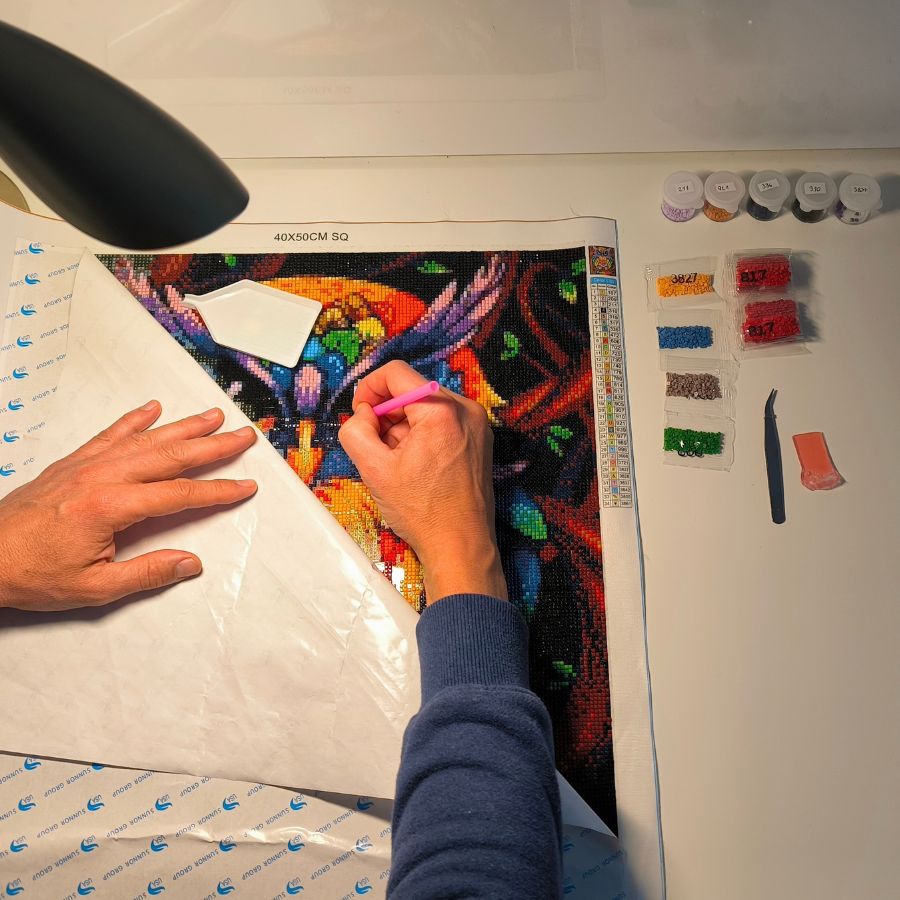
Before going deeper into drills, it helps to understand how the process works. You place small resin drills onto a sticky, symbol-coded canvas. Each symbol matches a color, and as you fill it in, the image gradually appears.
It’s similar to cross-stitch, but instead of thread, you’re working with faceted drills that reflect light.
What Are Diamond Drills?
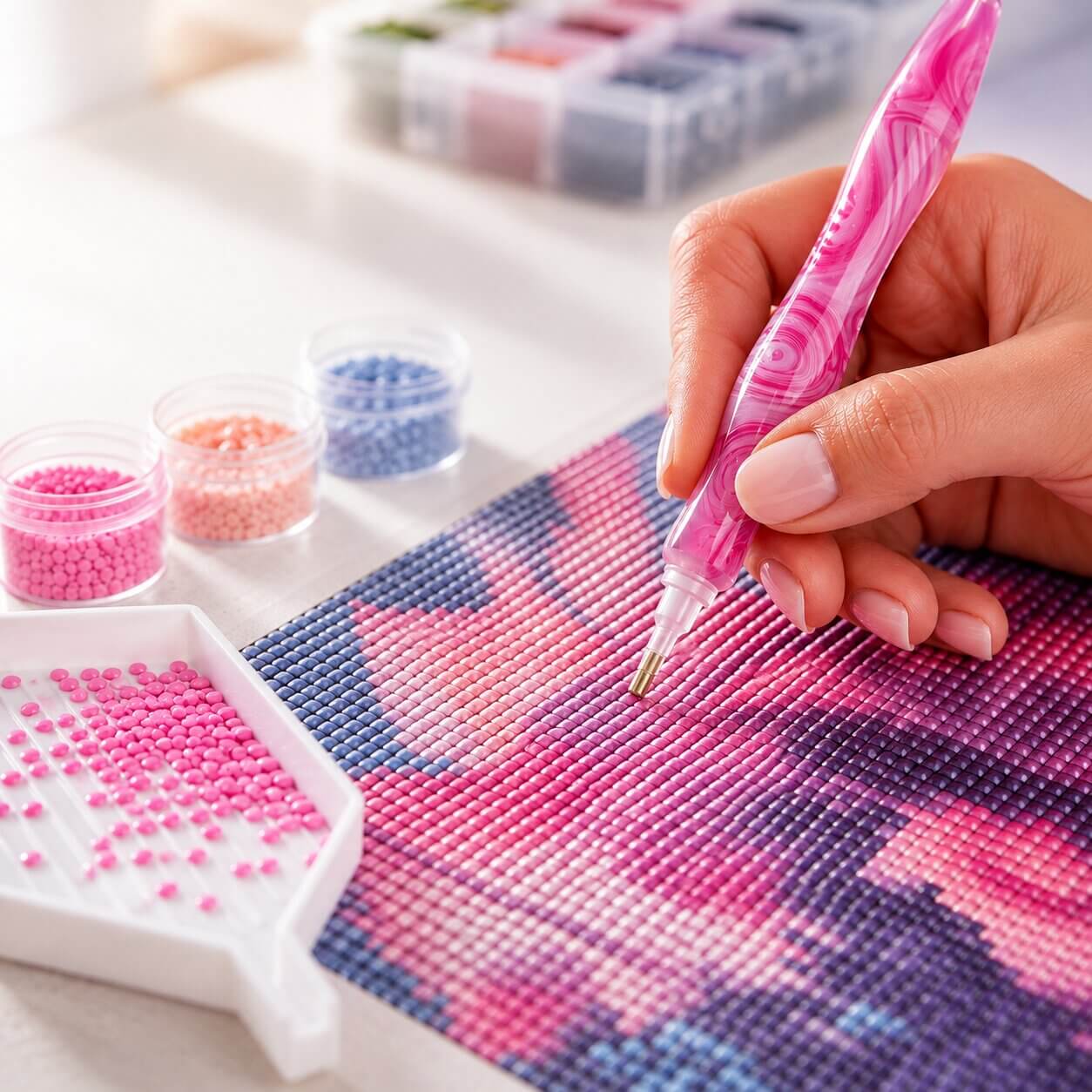
Diamond drills (also called diamond art drills or dots) are the basic building blocks of every kit. They are small resin pieces cut with multiple facets so they catch light once placed on the canvas.
When you look at a finished piece up close, you don’t see “paint.” You see hundreds or thousands of drills aligned next to each other, creating the final image.
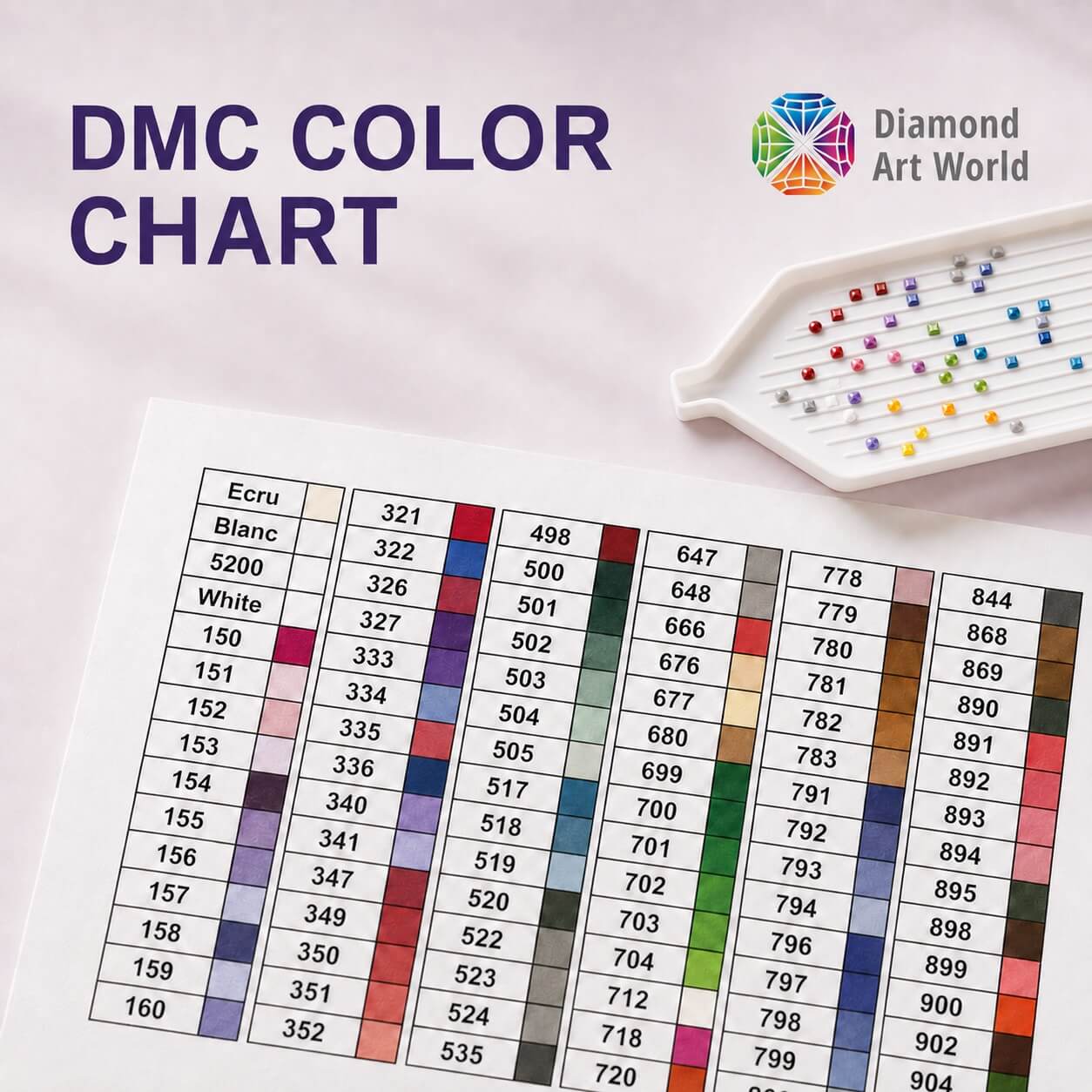
Standard drill colors are usually identified by a DMC number. Our diamond painting DMC color chart explains how these codes work and how many drills common canvas sizes contain.
What Is Full Drill Diamond Painting?
Full drill means the entire canvas is covered with drills, edge to edge. Every part of the image, including the background, is built from drills, so the whole picture sparkles evenly.
A partial drill kit covers only the main subject with drills. The background stays as a printed image, and these kits often use special shaped drills for highlights.
Full Drill vs Partial Drill: Which Should You Choose?
- Look: full drill gives a consistent, mosaic-like surface. In partial drill kits the flat printed areas can look dull next to the sparkling drills.
- Time: full drill takes longer, because every symbol on the canvas gets a drill.
- Best for: full drill suits most designs and anyone who wants the finished piece on the wall. Partial drill works for quick projects or designs built around one bright subject.
Most people who try both end up preferring full drill because the result looks more finished, even though it takes longer.
What Does "Full Plein" Mean?
"Plein" is the French word for "full", so a "full plein" kit is simply a full drill kit: the whole canvas is covered with drills. You may see the term in some kit listings. It does not describe a different type of diamond painting.
What Does 5D Mean in Diamond Painting?
The “D” in 5D does not literally stand for a fixed number of dimensions or an exact facet count.
In most kits, 5D drills usually have around 15 to 20 facets in total, often described as 5 facets per side. This higher number of facets helps reflect more light, which is why 5D drills appear brighter and more sparkly.
The term “5D” is mostly a marketing label used across the industry, and there is no strict universal standard across manufacturers.
Difference Between 2D, 3D and 5D Diamond Painting
The main difference is how the drills reflect light. 3D drills are usually described as having about three facets per side, which gives a softer shine. 5D drills have about five per side, so they create stronger reflections and a sharper look.
You may also see "2D" in some listings. There is no standard 2D drill: the term is used loosely for a flatter look with fewer facets than 3D.
Almost all modern kits already use 5D drills, so you rarely need to choose. The terms still matter when you compare older or very cheap kits, where fewer facets mean less sparkle in the finished diamond art.
Square Drill vs Round Drill Diamond Painting
The bigger decision is usually the drill shape. Both use the same canvas grid, but they behave very differently once you start placing them.
Square Drills
Square drills fit tightly next to each other with no gaps, so the finished image looks seamless and detailed. That makes them the better choice for portraits, photos and designs with fine lines.
The trade-off is precision. From experience, square drills can feel slow at the beginning: if one is even slightly crooked, it’s visible, and small errors add up along a row. Working row by row and straightening every few rows with a ruler or straightening tool keeps the lines clean.
Round Drills
Round drills are easier and faster to place. They don’t need perfect alignment, and the small gaps between them hide minor mistakes, which is why they’re often recommended for beginners.
The gaps also let a little of the printed canvas show through, so the image looks slightly softer than a square-drill version.
A lot of our customers start with round drills and switch to square later once they want more detail and a cleaner finish.

What Are AB Drills in Diamond Painting?
Another term you’ll see in kits is AB drills (Aurora Borealis). These are standard drills with a special iridescent coating that reflects extra light.
AB drills are usually used as accents on specific parts of the image (for example highlights, stars, or reflections). They stand out more than regular drills and add contrast to the finished piece.
They are not a different “type” of kit by themselves, but rather an addition inside a design. You can see examples in AB diamond painting kits where the extra shine is used to highlight specific details.
In some designs, too many AB drills can feel distracting rather than enhancing the image.

Other Types of Diamond Painting Drills
Besides standard round and square drills, you may come across other variations:
- Special drills: larger or uniquely shaped pieces (teardrop, crystal, etc.) used mostly in partial drill designs
- Crystal drills: transparent or glass-like drills that reflect light differently than resin ones
- Composite diamond drills: mixed or layered drills designed to create a more textured effect
- Glow in the dark drills: drills that absorb light and glow in low-light conditions, often used for night scenes or special effects
Glow in the dark designs are usually used as accents rather than full images. You can see examples in glow in the dark diamond painting kits where certain parts of the artwork become visible after dark.
These are less common in full drill kits and are mostly used for decorative or advanced designs.

Resin vs Acrylic Drills (Quality Difference)
Not all drills are made the same. Most modern kits use resin drills, but some cheaper kits use acrylic.
Resin drills are more consistent in shape, have sharper edges, and reflect light better. Acrylic drills can look duller and may have more defects or uneven cuts.
In real use, this shows up as cleaner lines with square drills and less frustration when placing them.
How Big Are the Diamonds in Diamond Painting?
Diamond painting drills are about 2.5 mm across, roughly a tenth of an inch. That is small enough that a single drill sits under a fingertip, but large enough to pick up with a pen tip without tweezers.
The size is the same across almost every brand and kit. It has to be, because the printed grid on the canvas is built around it. A drill that was noticeably larger or smaller would not line up with the symbols underneath.
Are Diamond Art Gems All the Same Size?
Standard round and square drills are, yes. What varies is how precisely they are cut. Small inconsistencies within the same batch are normal in manufacturing, which is why perfect alignment is never fully guaranteed.
Special drills are the exception. Teardrop, crystal, and other decorative shapes are often larger and are used as accents rather than across a whole canvas.
Why Drill Size Matters Less Than Consistency
With square drills, even small differences in cut can create gaps or push a row out of line. With round drills, the natural spacing hides those imperfections more easily.
Even with well-cut drills, the final look also depends on the canvas printing. If the grid is slightly off, square drills will not align cleanly no matter how carefully you place them.
Common Issues With Drills
A few problems show up often, especially in lower-quality kits:
- Popping drills: square drills lifting at the edges when they are pushed in too tightly or slightly uneven in size. Pressing finished rows flat usually settles them.
- Static: drills sticking together, especially in dry environments
- Color inconsistency: slight shade differences within the same color batch
These don’t ruin the experience, but they affect how smooth the process feels and how clean the final result looks. If you want to avoid most of these issues, it helps to choose a well-reviewed kit or read guides like common diamond painting mistakes before starting.
Summary
Diamond painting drills define both the look of the final image and how the process feels while you’re working. If you want something easy to start with, round drills are the safer choice. If you care more about detail and a seamless finish, square drills are worth the extra effort.
For most modern kits, a 5D full drill setup is the standard, which already gives a strong balance between detail and visual impact.